From the Field: What a North Georgia Farmer Can Teach Us About Product Management

How Nick Riggin of Riggin Farm is building a suite of farm and garden management apps — alone, in a farm store, between customers, chores, the everyday farming mishaps — and he accidentally ran the world’s most grounded product discovery process.
The Farm Store as a Product Lab
Nick Riggin didn’t set out to become a software developer. He set out to understand and manage the complexity of a sustainable farm.
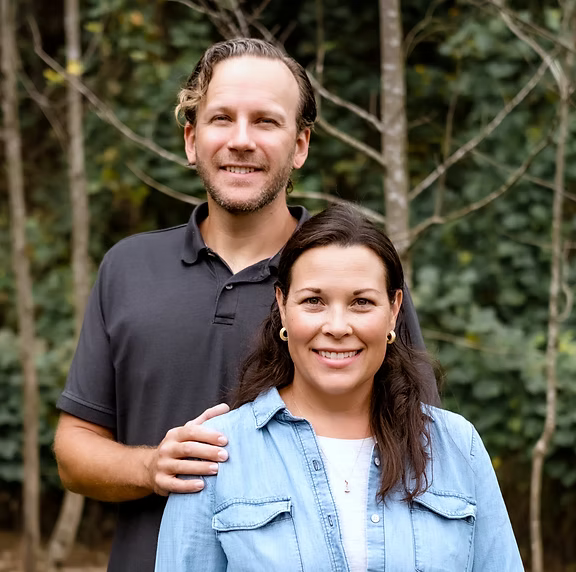
A culinary school graduate and twenty-year restaurant management veteran, Nick and his wife Ashley bought 25 acres of North Georgia pine trees and built Riggin Farm from scratch — regenerative, sustainable, and a dogged determination to healthy soil, healthy animals, and the highest-quality food they could produce. The farm has grown and today, they have a small on-site store, open three hours a day, where customers can pick up a variety of farm goods including eggs, pork, beef, seasonal vegetables, fresh bread, and a variety of good created from the farm resources.
And in this small farm-store, there’s software being created.
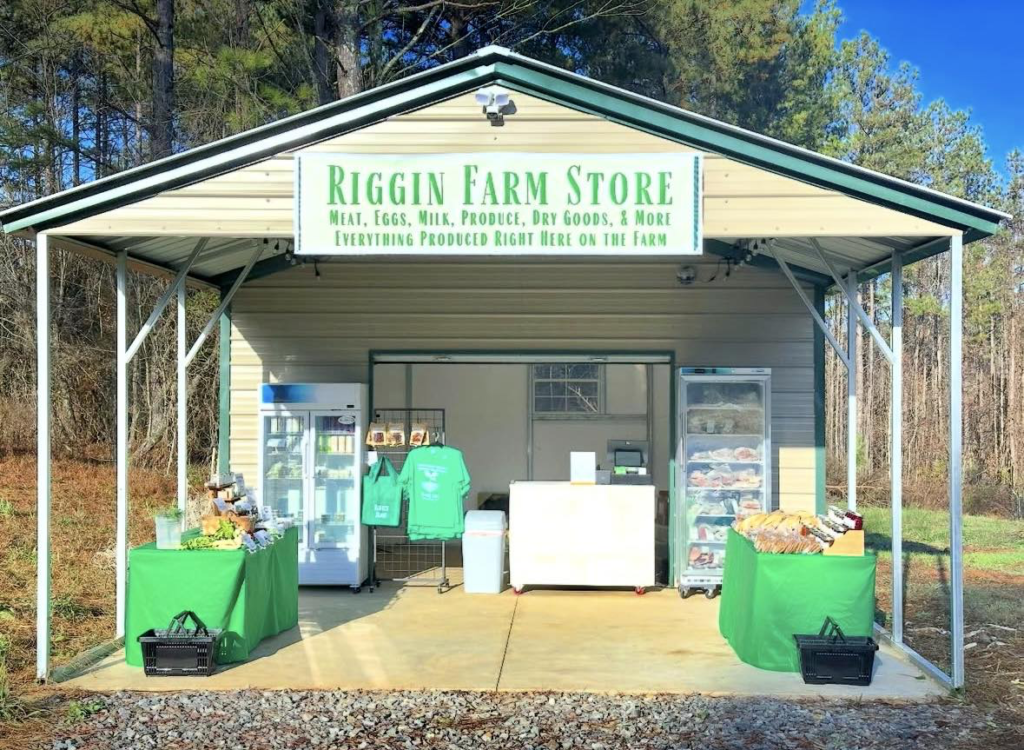
“I have downtime in between customers while the store’s open,” Nick explained in a recent conversation. “I was gonna work on YouTube videos, but the compressors on the freezers made recording impossible. So I just started building.”
What Nick built — over months of afternoons, on a laptop, between helping customers — is FarmForm, a suite of applications designed to help farmers of any scale run a genuinely profitable operation. There’s FarmForm Livestock, currently in Kickstarter launch. FarmForm Garden, currently being created which covers everything from vegetables to microgreens to mushrooms. And FarmForm Time Clock, a scheduling and payroll tool Nick originally built for the farm, then realized would be useful for any small business.
One farmer. Three apps. Zero engineering background (beyond one computer programming class in 2001 that he freely admits he’s forgotten). And, crucially, an AI coding assistant doing the heavy lifting on implementation.
It’s one of the best product development stories you haven’t heard yet.
The Best Discovery is Living the Problem
Classic product management says: talk to your users, understand their pain, then build a solution. Nick collapsed that process to its essence — he is the user and he’s living the pain.
“I’m solving my own problems,” he said. “I’m testing it in the field. Literally in the field. And I’m finding opportunities to improve, or things that don’t work, or things that I’m like, ‘I need to expand on this because this is incredible.'”
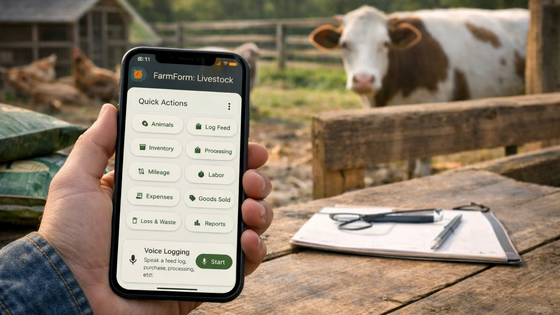
The seed of FarmForm wasn’t a market opportunity. It was a feed order. Nick was driving to the feed store and realized he couldn’t remember his inventory. “Now, I can just pull up my app,” he thought, “and see exactly how much I have on hand, how much I need to order, how many days of inventory I have left.” The app knew. The spreadsheet on his desk at home didn’t.
That’s a jobs-to-be-done insight in its purest form — not a survey, not a focus group, just a farmer in a truck wishing a tool existed that would allow him to see his on-hand inventory to feed his chickens. The tool didn’t exist. So he made it.
His numbers and P&L obsession from restaurant management gave him the financial framework. His on-the-ground farming experience gave him the data model. His culinary background gave him the instinct for the true cost of a product — not just ingredients, but labor, delivery fees, infrastructure depreciation, split fairly across each animal and each crop.
“I have the purchase price of that animal, how much food he’s eaten since I’ve had him, the mileage to take him to the butcher, the mileage picking him up, the processing costs. I have an exact cost to the penny of that animal.”
Most farmers, Nick says, don’t know those numbers. And not knowing them is costing them money — or the farm itself.
Prototyping Means Trying the Smallest Possible Thing First
Nick didn’t sit down one day and design a suite of farm management apps. He solved one small, irritating problem: he needed to log feed inventory without going inside to get his laptop.
The first prototype wasn’t even an app. It was a voice shortcut connected to a spreadsheet. Tap a button on his Apple Watch → “Fed the pigs” → data logged. No friction, no delay, captured in the field the moment it happened.
“The problem with spreadsheets is they’re on a computer, and when you’re farming you don’t necessarily have access to your computer while you’re in the barn or the pasture,” he explained. “I needed to create an app that can send information to a spreadsheet.”
That’s it. That was version one. Not the full FarmForm suite — just a way to tap a button on a watch and not lose the data.
What happened next is what happens in every good product development story: the more he used it, the more he saw. Each small problem solved revealed the next one. The feed tracker became an inventory manager. The inventory manager needed a cost layer. The cost layer needed to be animal-specific. The animal costs needed to interact with sales data. The sales data needed to talk to his point-of-sale system.
Today, FarmForm’s integration with his POS actually outperforms the POS vendor’s own reporting interface. “It loads faster, more accurately, and has better filters than what the POS actually has on their website.” He didn’t set out to beat a software company at their own product. He just kept solving the next thing that was annoying him.
Field Testing Is Not a Phase — It’s the Whole Process
There’s a well-worn product management concept called “eating your own dog food” — the idea that the people building a product should use it themselves. Nick didn’t have the luxury of separating build from use. He farms seven days a week. Every feature he ships, he uses the next morning.
“I literally use this app every single day I’m working on the farm,” he said. “And I’m solving problems. Something that I was like, ‘Man, it would be cool if this aspect of the app was way easier.’ And then I’m like, ‘Well, I can just make it easier.'”
This tight feedback loop is what most enterprise software products would kill for. Most development cycles measure feedback in sprints (two-weeks), quarters, or release cycles (months). Nick’s feedback cycle is 24 hours, and the user filing the bug report is also the one fixing it.
He made an observation that cuts to the heart of why so much software fails farmers (and plenty of others): “There actually is a gardening app we have that my wife has a lifetime subscription for. They were doing a livestream introducing new features. They had seven full-time developers for this app that is way less complex than what I’m doing by myself in my spare time.”
A team of seven, building a simpler product. One person, who farms for a living, building a more complex one. The difference isn’t raw engineering talent. It’s the quality of the feedback loop. When the product manager, the designer, the QA engineer, and the primary user are all the same person standing in the same field every morning, you don’t waste cycles building the wrong thing.
Jobs to Be Done — and the Wisdom to Not Over-Fit
One of the sharpest product instincts Nick demonstrated was resisting the urge to build his app. Riggin Farm is regenerative and sustainable — a philosophy that shapes every decision they make on the land. But FarmForm isn’t a regenerative farming app.
“If I target it towards our farming methods and our approach, I would be limiting my customer base drastically,” he said plainly. “I wanted to make the app very broad.”
FarmForm is instead a profitability and management tool that works for any agricultural operation — homesteaders, 10,000-acre operations, livestock farmers, market gardeners, agritourism businesses, microgreen growers. Features are modular and toggled by need. A farm that doesn’t process animals never sees the processing menu. A farm without agritourism can hide the tours-and-workshops tab entirely.
That’s jobs-to-be-done thinking applied with discipline: understand the actual job — I need to know if my farm is profitable — and resist decorating the solution with assumptions about how the user runs their farm.
Nick also talked about something product managers call the “adoption curve” problem. Farmers, he noted, tend to be more introverted and set in their ways. Getting them to see the value in a new tool requires demonstrating impact on their terms, not yours. “Even in restaurant management, if an employee didn’t see the value in something, they weren’t committed. I’d ask: what value does this add? Tell me how it’s going to make the company more successful.”
He’s already fielding those conversations at the farmers market, with homesteaders who tell him they don’t know how much they’re spending on animal feed — and don’t know they’re losing money on the things they sell. That’s the wedge. The financial clarity is the value proposition. The rest is just convincing them to look at the numbers.
AI Didn’t Replace the Builder — It Replaced the Barrier to Entry
The elephant in the room of this whole story is the AI coding assistant, and Nick is clear-eyed about both what it does and what it doesn’t do.
“I went into ChatGPT and said, ‘I want to create an app to keep track of my feed and my inventory.'” That first app, in the early days, was going to be a simple 99-cent utility. Then it just kept growing. He moved to GitHub Copilot, embedded in VS Code, and found that the tighter integration made the iteration loop much faster. He can describe what he needs, see code generated, test it, and refine it — without leaving the development environment.
But it isn’t magic, and he’s careful not to sell it as such. “AI is only as good as the prompts you give it” is conventional wisdom he partly pushes back on — because he’s found that even good prompts sometimes produce results that take two hours of debugging to fix. “I don’t know why it just couldn’t grasp that one concept for a couple hours. But now it works.”
What AI gave Nick isn’t skill. It’s access. He had the domain expertise, the financial framework, the user empathy, and the relentless motivation. What he lacked was a way to translate those into working software. The AI tools he’s using bridged that gap.
The broader implication — and Nick touches on this directly — is that the traditional product development team (product manager, designer, engineer, QA, tester) is collapsing into something smaller and faster. Not because people aren’t needed, but because a sufficiently motivated domain expert with AI tools can now run the entire loop themselves. “Whether or not you were previously an engineer, now you can just go build something and try it out and start proving out the idea.”
The risk, of course, is that most people trying this don’t have Nick’s depth of lived experience with the problem. The AI can generate code. It cannot generate twenty years of knowing what a P&L is supposed to look like, or what it costs to fence in four cattle, or why the price of lettuce at a farmers market actually makes sense when you factor in what didn’t make it to market.
That expertise is the product. The AI is just the shovel.
Why This Story Matters Beyond the App
Riggin Farm exists to prove that food can be grown differently.
The regenerative farming model — healthy soil, natural pest control, animals raised the way nature intended — isn’t just an ethical preference. Nick argues it’s a survival imperative. “Almost every major civilization that has gone extinct, it’s because of agriculture. They desertified the land and made it to where they couldn’t grow anything anymore. We’re kind of doing the same thing with conventional ag.”
He tells a quieter version of the same story in his product: a farm that doesn’t know its true costs will eventually fail. A farm that can’t demonstrate profitability can’t attract the next generation, can’t invest in regenerative practices, can’t keep the land healthy. FarmForm is, at its core, an argument that sustainable farming and sustainable business are the same thing — and that farmers deserve tools built for how they actually work.
Riggin Farm is producing healthy, sustainable food for the community and their family. Nick’s wife Ashley can’t normally eat pork. She eats Riggin Farm pork just fine. A customer noticed a spider on a head of lettuce and took it as proof the farm doesn’t use pesticides. Nick’s response: “He is the pesticide. We’re not going to kill him.”
That’s the farm. That’s also, improbably, the product philosophy: work with the system that’s already there. Don’t force something that doesn’t fit. Let nature — or the user — do what it does best.
How to Help
- Support the Kickstarter: FarmForm Livestock is live on Kickstarter now. Nick has invested hundreds of hours building something genuinely useful for farmers at every scale. Every dollar of funding goes toward getting the tool into more farmers’ hands.
- Buy local, ask questions: Find a farm near you doing it the right way. Ask how they raise their animals. Ask what they put on their soil. If a farmer hesitates or hedges, keep looking. The right farmer will welcome the questions.
- Follow the farm: Riggin Farm documents what regenerative farming actually looks like on Facebook and YouTube — not the curated version, the real one.
- Spread the word: The biggest challenge for small farms isn’t production. It’s awareness. Tell someone about FarmForm. Tell someone about Riggin Farm. Tell someone to look into where their food comes from.
Nick Riggin is the founder of Riggin Farm in North Georgia and the developer of the Farm Form suite of farm management applications. FarmForm Livestock is currently available on Kickstarter.